Swiss EP Annual Report 2025 - Executive Summary
Report of Swisscontact to SECO on the implementation of Year 1 of Phase III of the Swiss Entrepreneurship Program.
In 2025, Swiss EP continued to make substantial progress in strengthening emerging startup ecosystems across the seven partner countries. The program deepened its focus on supporting scale‑ups, elevating partner organizations (POs), and reinforcing the systemic foundations needed for long‑term ecosystem resilience. Despite a global investment environment marked by selective capital flows, a sharp decline in early‑stage funding, and tightening economic conditions across many emerging markets, several Swiss EP ecosystems, particularly in Albania (ALB), Vietnam (VNM), and Peru (PER) demonstrated encouraging advances.
Ecosystem developments in 2025 were shaped by a mix of global and local factors. International financial institutions highlighted a continued worldwide contraction in early‑stage finance and founders in advanced markets still receive 37 times the capital available to founders in emerging economies.2 These trends were clearly felt across Swiss EP countries, requiring the program to adapt by prioritizing investment‑readiness support, founder‑centered advisory, and scale‑up engagement. Political volatility and donor withdrawal, especially in the Western Balkans (WB), added further pressure, underscoring the importance of Swiss EP’s long‑term embedded presence and its trusted relationships with POs, founders, and policymakers.
Across the portfolio, progress varied by country. ALB exhibited renewed dynamism with Plug & Play’s first cohort and increased government commitment. VNM advanced rapidly due to major regulatory shifts supporting innovation, technology adoption, and the introduction of state‑supported venture capital funds. PER underwent structural recalibration with new IDB financing and strengthened PO governance, though startup quality and investment depth remain uneven. In contrast, BIH and MKD showed stability but limited scale‑up pathways, while SRB transitioned from strong growth to resilience amid political and institutional disruptions. RKS faced significant structural challenges following the withdrawal of major donors and limited public‑sector engagement, though strong founder communities and diaspora interest provided pockets of optimism.
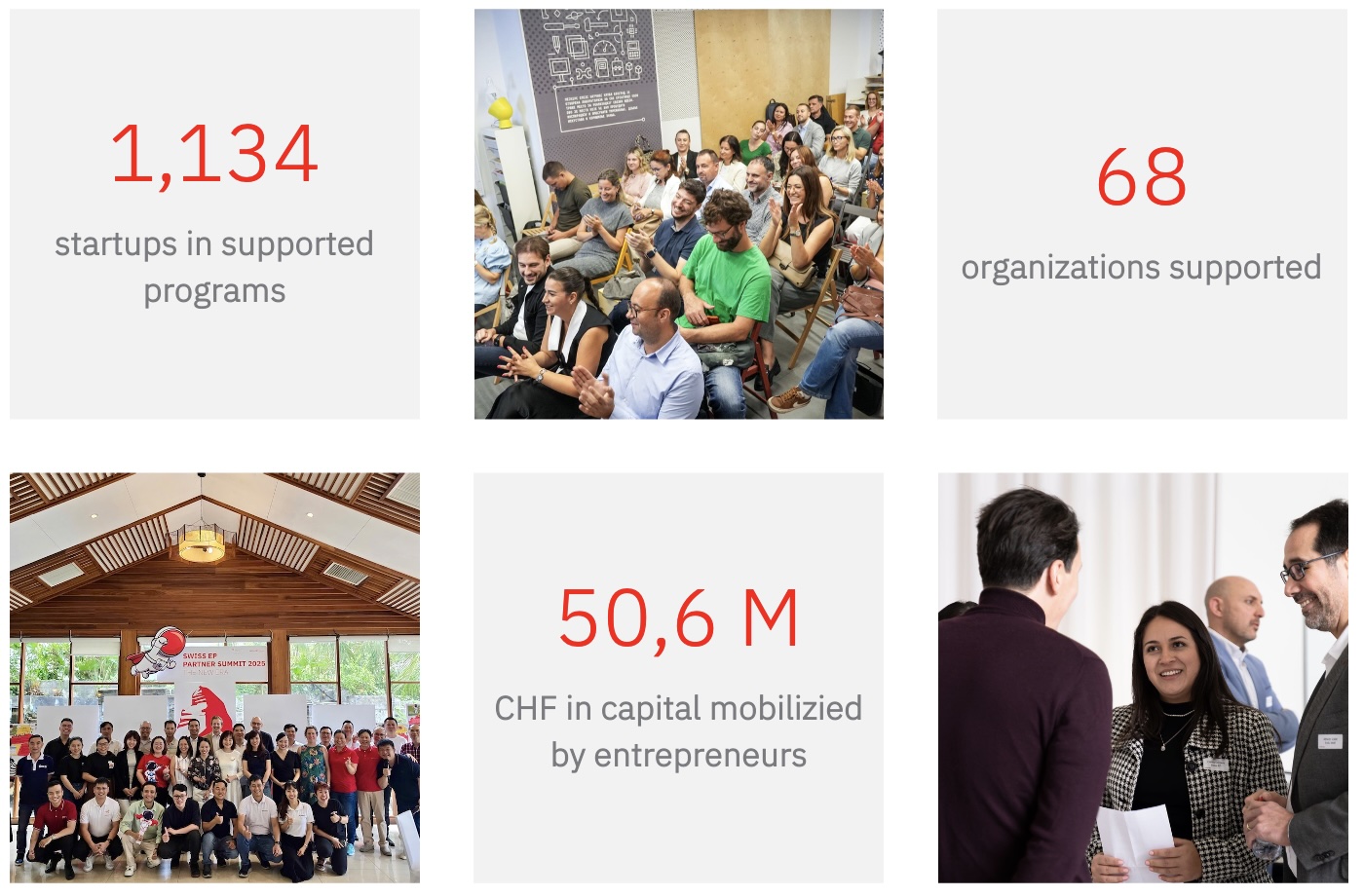
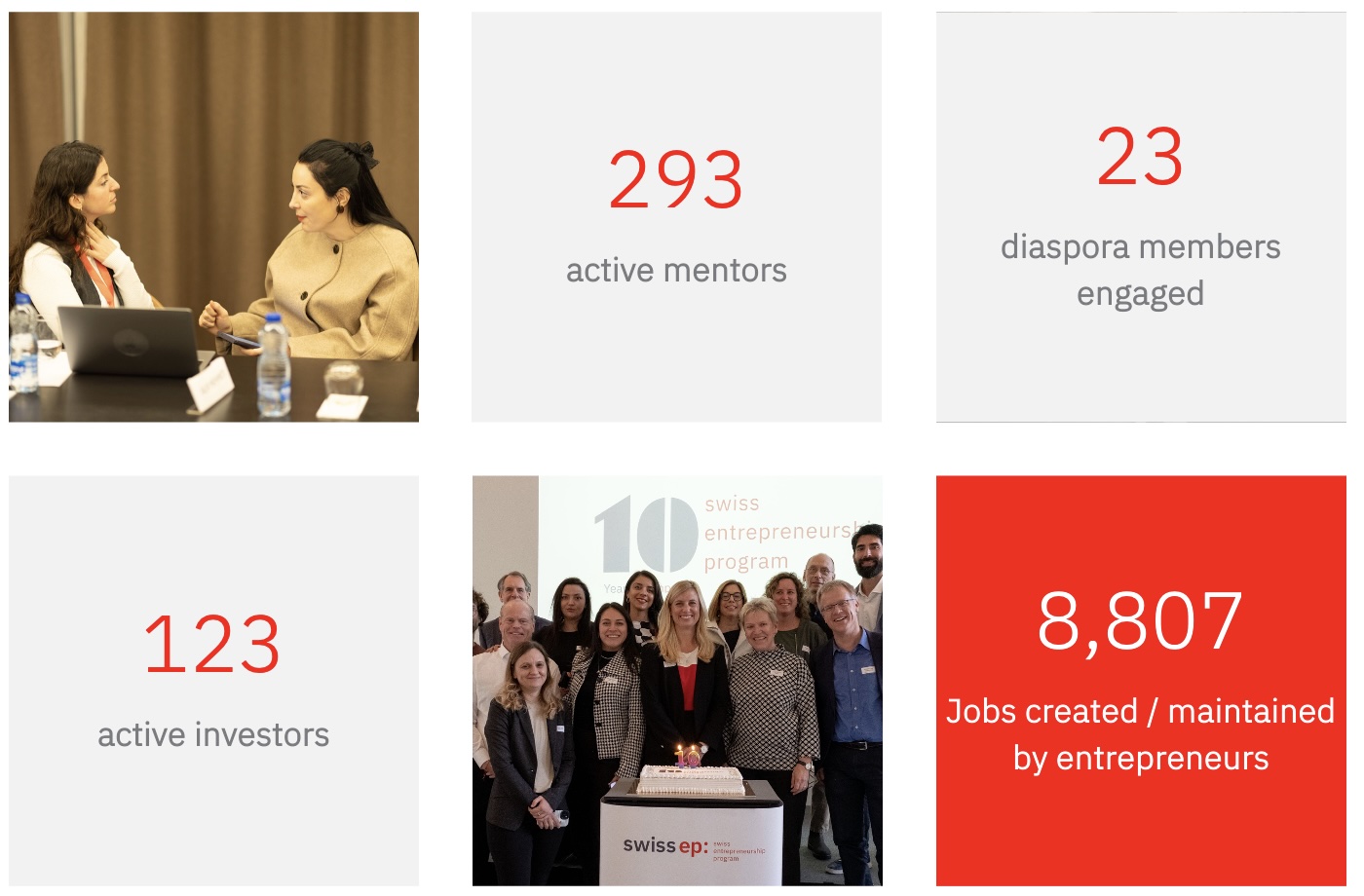
The results achieved in 2025 reaffirm Swiss EP’s contribution to building robust, founder‑led ecosystems. The 20 largest startups per country generated 8,807 jobs, reaching 82% of the Phase III target. Employment growth remained positive across most countries and continued to exceed pre‑2020 levels, despite tighter capital markets. Beyond the validated Top 20 figures, Swiss EP- supported POs engaged 20,597 founders and entrepreneurs, demonstrating the program’s broader systemic reach.
Capital mobilization remained challenging in a globally selective market but still reflected notable resilience. Startups associated with Swiss EP raised CHF 50.62 million, bringing the cumulative Phase III total to CHF 97.88 million still substantially under the target. VNM, SRB, and PER continued to drive most of the investment volume, with VNM alone accounting for more than half of 2025 capital raised. Smaller and less mature markets, ALB, BIH, RKS, remained highly sensitive to single transactions due to shallow investor bases. SRB and VNM continued to serve as leaders for innovation activity, mobilizing CHF 9.80M and CHF 26.85M respectively in VC-linked capital, confirming their alignment with global venture trends in AI, fintech, and enterprise SaaS.
Scale‑up support, one of the core innovations introduced under Phase III, continued to expand. In 2025, Swiss EP supported 22 scale‑ups, bringing the cumulative total to 32. These companies represent the most promising engines of future job creation, capital mobilization, and international competitiveness. Stronger pipelines were observed in PER, VNM, and MKD, with notable growth from scale‑ups such as NetZero Pallet (VNM), Preauth (PER), and Bio422 (MKD). Their progress illustrates the value of Swiss EP’s tailored, founder‑centered advisory model and hands‑on expert support.
Mentorship and active investors additionally strengthened ecosystem capabilities. Swiss EP recorded 293 active mentors in 2025 (390 cumulatively), reaching 88% of the Phase III target. Female mentor participation remained particularly strong in BIH, PER, and VNM. Investor activation progressed steadily, with 123 active investors recorded in 2025, close to the Phase III target of 130. Cross‑border investor retreats, angel academy programs, and diaspora-led initiatives in the WB contributed to stronger investor networks and improved deal-readiness.
Women entrepreneurs continued to play an increasingly prominent role. Women‑led startups raised CHF 10.36 million in 2025 (20.5% of total capital raised), contributing to a cumulative CHF 25.16 million during Phase III. Participation rates among women founders were particularly high in BIH and PER, while MKD, RKS, and SRB saw increased engagement of female angel investors and ecosystem leaders, indicating a shift from inclusion toward influence.
Policy dialogue gained further relevance in 2025. In VNM, Swiss EP contributed directly to the development of national VC fund regulations and served as a trusted ecosystem advisor to the government. In MKD, ALB, and BIH, authorities increasingly sought Swiss EP’s expertise to shape local strategies. In the WB, Swiss EP’s long-standing presence positioned the program as a key reference point for donor coordination and private‑sector development.
Diaspora engagement grew significantly from 8 diaspora members in 2024 to 23 in 2025, supporting access to international networks, expert guidance, and early-stage angel activity. In RKS, a new Diaspora Retreat model showed strong potential for replication.
The program’s visibility reached new heights, spurred by the 10‑Year Anniversary celebration in Basel and associated communication campaign. The GEW Basel event, attended by over 70 stakeholders and featuring SECO leadership, strengthened Swiss EP’s profile as a flagship SECO initiative. Across PER, VNM, Switzerland, and the WB, active participation in major ecosystem events further increased donor visibility.
Lessons from 2025 reinforce Swiss EP’s agile, bottom‑up approach as a core differentiator. The program’s ability to pivot toward scale‑ups, adapt to donor exits, navigate political contexts, and strengthen cross‑border collaboration has remained central to its sustained relevance. While challenges persist, ranging from limited early‑stage pipelines in some countries to increased sophistication of scale‑up needs, Swiss EP continues to address these through specialized expert support, strengthened PO capacity, and deep ecosystem engagement.
Taken together, the 2025 results confirm that Swiss EP remains a key driver of entrepreneurial ecosystem development across all seven partner countries. The program continues to validate SECO’s long‑term commitment to market‑driven, inclusive private‑sector growth and is helping lay the foundation for resilient, self‑sustaining ecosystems well beyond the end of Phase III.